Chamber
Online prescription writing: how it works, rules & free tools (2026)
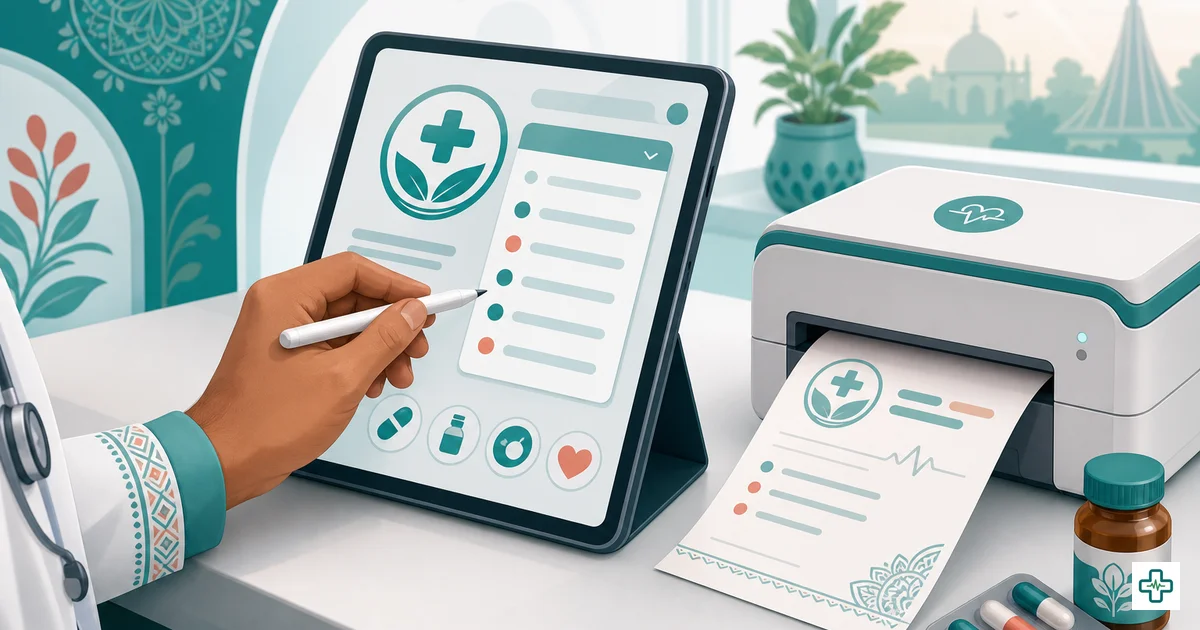
Writing a prescription used to mean a paper pad and a pharmacy queue. Online prescription writing lets a registered doctor in Bangladesh produce a clean, legible, verifiable prescription straight from a laptop or phone — whether the patient is sitting across the desk or following up over a video call. The medicine names come out readable, the chamber details and BMDC number are printed on every copy, and the patient can keep a digital copy that never gets lost on the bus home. This guide explains what online prescription writing actually means in Bangladesh, when it is appropriate, what the rules say, how to do it step by step, and which free tools you can start with today.
If you would rather try it than read about it, open our free prescription generator in a new tab, write a prescription in your browser, and print or download it — no sign-up, no payment. The rest of this page covers the decisions worth making first, so the prescriptions you produce are not just neat but safe and defensible.
What "online prescription writing" actually means
The phrase covers two different things that often get blurred together, and keeping them apart will save you confusion:
- Writing the prescription digitally. The patient is physically in front of you — a normal chamber visit — but instead of scribbling on a paper pad you type the prescription into a tool and print it (or save it as a PDF, or send a link). The consultation is in person; only the writing moved online. This is the safest and most common form, and it is exactly what most doctors mean by an e-prescription.
- Remote prescribing in telemedicine. The patient is not in the room at all; you assess them over phone, video or chat, and you both write and deliver the prescription online. Here, writing prescriptions in telemedicine is appropriate only in defined situations, which we cover below.
In both cases the end product is the same: a structured, legible online prescription carrying your name, qualifications, BMDC registration number, chamber details and a signature space. The terms e-prescription, digital prescription and online prescription are used almost interchangeably; what matters legally is not the format but who issued it and how. For a deeper look at the rules behind the writing itself, see our guide on prescription writing rules in Bangladesh.
When online prescription writing is appropriate — and when it is not
Typing instead of handwriting is always fine. The real judgement is about remote prescribing: deciding whether a patient you have not physically examined should receive a prescription at all. A reasonable, conservative rule of thumb for doctors in Bangladesh:
| Situation | Online prescription writing | Why |
|---|---|---|
| In-person chamber visit, written digitally | Always suitable | You examined the patient; only the writing moved to a screen. |
| Telemedicine follow-up of a patient you already know | Usually suitable | You have an established diagnosis and history; you are adjusting or continuing treatment. |
| Repeat of a stable long-term medicine | Often suitable, with review | A known patient on stable therapy can be continued, but reassess periodically. |
| A brand-new symptom that needs a physical exam | Not suitable remotely | Chest pain, a lump, an acute abdomen and similar need examination — see the patient. |
| Controlled or high-risk drugs without prior assessment | Not suitable | Higher-risk medicines demand a proper, documented assessment first. |
| Anonymous request with no identity or history | Never suitable | You cannot verify who the patient is or take responsibility for the prescription. |
The safe default is simple: if you could not justify the prescription to a colleague reviewing the case, do not write it remotely. When in doubt, ask the patient to come in. For the framework that governs remote consultations, read our telemedicine practice guide for Bangladesh.
Is online prescription writing legal in Bangladesh?
Yes — with one non-negotiable condition. What makes a prescription valid is not whether it was typed or handwritten, but that it was issued by a doctor registered with the Bangladesh Medical & Dental Council (BMDC), carrying that doctor's identity, registration number and signature. Only BMDC-registered doctors may prescribe medicines for real patients. A printed or PDF prescription from an online tool is just as valid as a paper one, provided the doctor who issued it is registered and identifiable.
Two practical points follow from this. First, your identity must be clear on the document: full name, qualifications and BMDC number, so any pharmacy can trust it. Second, the prescription should carry a signature — a scanned signature, a signature space you sign before handing over, or a verifiable digital link all serve this purpose. This is general information rather than legal advice, and the detail of digital signatures and record requirements is covered in our guide on digital prescription legality in Bangladesh. If you are unsure who may legally write a prescription at all, see who can write a prescription in Bangladesh.
How to write a prescription online, step by step
The mechanics are quick once your header is set up. Using a tool like our free prescription generator, the flow looks like this:
- Set up your header once. Add your name, qualifications and BMDC registration number, your chamber name, address and hours, and upload your logo. You configure this a single time; it then prints on every prescription automatically.
- Choose your mode. Use Classic for a structured form — patient details, then each medicine with its dose, frequency and duration, then advice — or Canvas for a blank pad you write on freehand with a mouse, finger or stylus, the way you would on paper.
- Enter the patient's details. Name, age and sex at minimum; date is added automatically. Accurate patient identity matters as much online as on paper.
- Add each medicine clearly. Write the drug name in full, then dose, frequency and duration on the same line. With a free ChamberBD account you also get a 23,000+ medicine autocomplete database that helps you pick the correct name and spelling.
- Write your advice and follow-up. Investigations, lifestyle advice, warning signs and when to return. Clear follow-up instructions are part of safe prescribing.
- Deliver it. Print it for an in-person patient, save it as a PDF or PNG image, or create a share link the patient can open on any phone (the free link expires after 7 days). Your draft also autosaves in the browser so a refresh never loses your work.
That is the whole loop. For a focused walkthrough aimed at first-timers, see how to make a prescription online for free.
Avoiding errors: the part that actually protects patients
A neat layout is not the same as a safe prescription. The most common — and most dangerous — mistakes in prescribing are about content, not format: an illegible or ambiguous drug name, a missing dose, an overlooked allergy, or a drug interaction. Online writing fixes legibility for free, but the clinical checks are still yours. Use this checklist every time:
| Do | Don't |
|---|---|
| Write the full drug name, dose, frequency and duration on one line | Don't abbreviate a drug name in a way a pharmacist could misread |
| Confirm the patient's known allergies before prescribing | Don't assume "no allergy" because the patient did not mention one |
| Check for interactions with the patient's existing medicines | Don't prescribe in isolation from what they already take |
| State quantity and any maximum daily dose where relevant | Don't leave "as needed" without a limit or a stop point |
| Add clear follow-up and warning signs | Don't end without telling the patient when to return |
| Verify the patient's identity, especially in telemedicine | Don't prescribe for an unverified or anonymous request |
If a common abbreviation ever looks ambiguous on screen, spell it out — clarity beats brevity. Our reference on how to read prescription abbreviations is a useful companion when you want a shared, unambiguous shorthand with the pharmacy.
Keeping a record of online prescriptions
One quiet advantage of writing online is that a record can exist automatically — but only if you set it up to. A standalone generator keeps your draft on the device until you choose to share it, which is private and fast but means the record lives wherever you saved the PDF. That is fine for occasional use. Once digital prescribing becomes a habit, you will want every prescription stored, searchable and tied to a patient history, so a follow-up is one search away rather than a hunt through downloads.
This is where a free ChamberBD account changes the picture. Alongside the autocomplete database, it keeps full patient records and history, gives every prescription a permanent QR-verified link (so a pharmacy can confirm it is genuine), and lets you reuse prescription templates for the conditions you treat most. Good record-keeping is not just convenience — it is part of practising safely and is expected of you. Our guide on prescription writing rules goes into what a complete record should contain.
The tools: free generator vs free account
You do not have to choose perfectly on day one. Start with whichever fits today and grow into the other:
- The free prescription generator. Open the generator, write, print or download — no account. Two modes (Classic and Canvas), custom header and logo with crop, footer text, header/footer and page colours, watermark, print, PDF, PNG, and a 7-day share link. Everything runs in your browser and your data stays on the device until you share. Ideal for trying online prescription writing or for a doctor who only needs a clean printed copy.
- A free ChamberBD account. Create a free account (with a 14-day Pro trial) when you want the 23,000+ medicine autocomplete, patient records and history, permanent QR-verified prescription links, online appointments, serials, a queue display and SMS reminders, reusable templates, and income and reports. This is the system you settle into once digital prescribing is your daily routine.
If you want a wider comparison of free versus paid options, our overview of free e-prescription software in Bangladesh lays out what to look for before you commit.
Frequently Asked Questions
Is online prescription writing legal in Bangladesh?
Yes. What makes a prescription valid is not the format but a registered doctor's identity and signature. A prescription typed online and printed or shared as a PDF is just as valid as a paper one, as long as the doctor who issued it is registered with the Bangladesh Medical & Dental Council (BMDC) and is clearly identifiable on the document.
Can I write a prescription online for a patient I have not examined?
Only in defined situations. Typing a prescription for an in-person patient is always fine. Prescribing remotely — without a physical exam — is generally appropriate only for a follow-up of a patient you already know, or to continue a stable long-term medicine, and never for a brand-new symptom that needs examination, for high-risk drugs without prior assessment, or for an anonymous request.
Do I need to sign an online prescription?
Yes, in effect. The document should carry something that ties it to you: a scanned signature, a signature space you sign before handing it over, or a verifiable digital link such as a QR-verified prescription. The signature, together with your name and BMDC number, is what lets a pharmacy trust the prescription is genuine.
Is there a free tool to write a prescription online?
Yes. The ChamberBD prescription generator is free, runs entirely in your browser, and needs no sign-up. You can write a prescription, customise your header and logo, and then print it, save it as a PDF or PNG, or share a link that works on any phone for seven days. A free account adds a medicine database, patient records and permanent verified links.
What is the difference between an e-prescription and a normal prescription?
Only the medium. An e-prescription (also called a digital or online prescription) is written on a screen and printed or shared digitally instead of being handwritten on a pad. The clinical content and the rules are identical; the digital version is simply more legible, easier to store, harder to lose, and quicker to resend if the patient misplaces it.
Can chamber staff write the prescription for the doctor?
Staff can help prepare and lay out a prescription — entering patient details or printing the final copy — but the clinical decisions and the responsibility remain the doctor's. Only a BMDC-registered doctor may decide what is prescribed and issue it under their name and signature. Staff support speeds up the process; it does not transfer the prescribing authority.
Start writing online today
Online prescription writing is not a gimmick — it is a faster, cleaner, more verifiable way for a registered doctor in Bangladesh to do something they already do every day. Open the free prescription generator and write one now with no sign-up, or create a free ChamberBD account when you are ready for patient records, a medicine database and permanently verifiable prescriptions. This article is general information and not a substitute for a doctor's clinical judgement; only doctors registered with the BMDC may issue prescriptions for real patients.