Chamber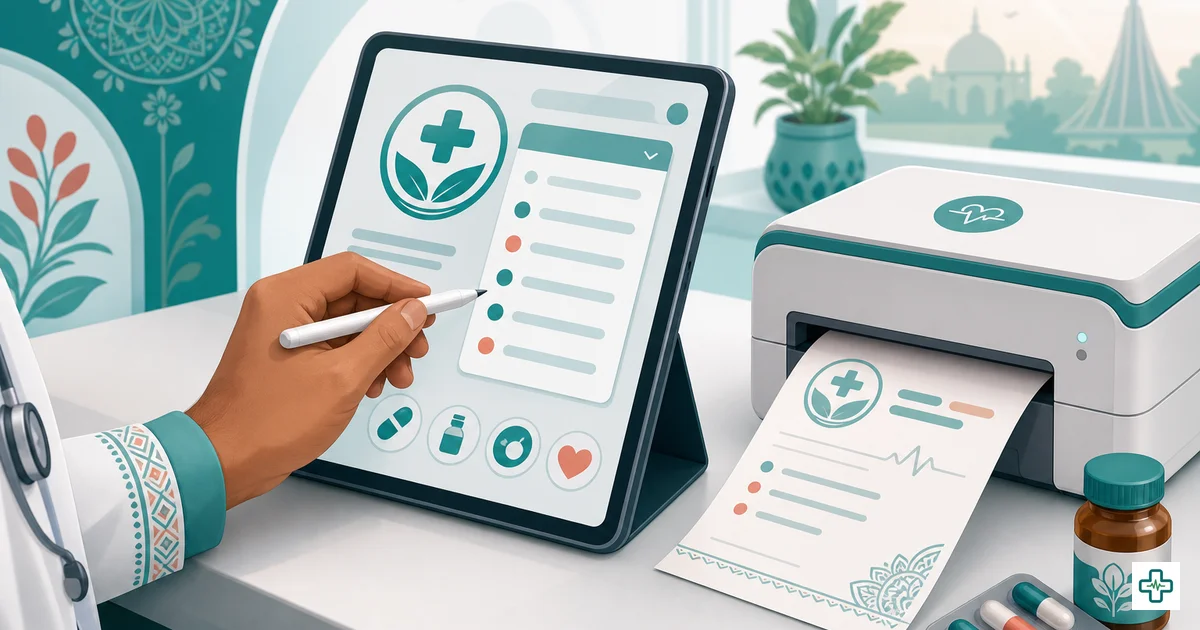
Digital prescription system for clinics in Bangladesh (2026)
In a busy multi-doctor clinic in Bangladesh, the prescription pad is still the last piece of paper running the show. Three or four doctors share the same waiting room, the same serial, often the same patients across visits — yet each one writes by hand on a separate pad, in their own handwriting, with no record of what the patient was given upstairs last month. As patient volume climbs, that handwritten habit quietly becomes the clinic's biggest source of friction and risk. A digital prescription system for clinics fixes it: every doctor prescribes from the same structured tool, on the same 23,000+ medicine database, onto branded Rx-paper, with each prescription tied to the patient's shared history. This guide explains why clinics in Bangladesh are making the switch in 2026, what a real clinic prescription software looks like, how it handles the genuine concerns — learning curve, internet — and exactly how ChamberBD Clinic's prescription builder works.
If you run more than one doctor under one roof, the question is no longer whether to go digital but how to do it as a clinic — shared, not as four disconnected solo tools. That distinction is the whole point of this page. For the solo doctor's version of the story, our guide to free e-prescription software in Bangladesh covers the standalone generator; here we focus on the multi-doctor clinic.
What a digital prescription system for a clinic actually is
An e-prescription software for a clinic replaces every doctor's paper pad with one shared, structured prescription builder. Instead of scrawling a drug name and hoping the pharmacist reads it, the doctor searches a medicine catalogue, picks the drug, sets the dose, meal timing and duration on a grid, adds symptoms, tests and vitals, and the system lays it out as a clean, printable prescription on the clinic's own letterhead. Because it is a clinic system and not four separate generators, three things change that matter enormously at scale:
- One shared medicine catalogue. Every doctor searches the same published 23,000+ medicine database, so a drug is spelled and dosed consistently no matter who prescribes it.
- One shared patient pool. When the cardiologist opens a patient, she can see that the same patient saw the medicine specialist last week — because the prescription is tied to a single patient record, not to one doctor's private pad.
- One clinic identity. Every prescription prints on Rx-paper carrying the clinic's letterhead, and in a multi-branch clinic it stamps which centre it came from. The patient walks out with one consistent, professional document, not four different-looking scraps.
This is the line between electronic prescription for a clinic and a personal prescription maker. A solo generator makes one doctor's prescription look better. A clinic system makes the whole clinic safer, faster and more professional — and gives the owner a real record of what is being prescribed across every chair.
Why multi-doctor clinics are moving off handwritten pads
The shift is not about looking modern. It solves specific, daily problems that every clinic owner and consulting doctor recognises the moment volume rises.
Legibility and patient safety
"Doctor's handwriting" is a national joke until a pharmacist dispenses the wrong drug because two names looked alike, or a patient misreads a dose at home. In a clinic with several doctors, the risk multiplies — and the clinic's name is on every one of those pads. A printed prescription removes the legibility problem entirely. It is the single biggest safety win of going digital, and at a clinic it protects the brand as much as the patient. When a medicine is chosen from a structured catalogue with the dose set on a grid, an entire class of transcription errors simply disappears. If your front desk or junior doctors ever struggle to decode an older handwritten Rx, our explainer on how to read prescription abbreviations shows exactly why structured digital entry beats shorthand.
A shared 23,000+ medicine database with dosing
The heart of a clinic prescription system is the catalogue. ChamberBD Clinic ships with a shared, published database of more than 23,000 medicines that every doctor in the clinic searches from the same mobile-friendly search box. The doctor types a few letters, the right brand appears, and the dose grid, meal timing and duration are entered in a structured way rather than written out as a sentence. Because the catalogue is shared, a senior consultant and a new associate prescribe the same drug the same way — no private shorthand, no guessing at a brand the pharmacy has never heard of. That consistency is impossible to achieve with four separate paper pads.
Faster Rx during a busy serial
When a clinic is running 80, 120, 200 patients across the evening serial, seconds per prescription become minutes of waiting-room queue. Selecting a medicine from a database, where the dose is set on a grid instead of written line by line, is dramatically faster than handwriting each instruction — especially for the repeat regimens a doctor prescribes ten times a day. ChamberBD Clinic lets each doctor build a personal medicine shortlist, so the drugs they reach for most are one tap away, while the full 23,000-medicine catalogue stays a search away for everything else. The "Rx" button is wired straight into the appointment, so the doctor moves from calling the serial to writing the prescription without leaving the patient's screen. Shaving even thirty seconds off each prescription across a 150-patient evening is over an hour of recovered time — and a visibly shorter queue. If reducing that queue is your real goal, it pairs naturally with the workflow ideas in our broader clinic management software guide.
Professional, branded Rx-paper
A clean prescription on the clinic's own letterhead tells the patient they are in careful, organised hands. ChamberBD Clinic prints onto proper Rx-paper that carries the clinic's letterhead, and a composite view brings the doctor, patient, symptoms, tests and medicines together into one professional document. In a multi-branch clinic the printed prescription stamps which centre it was issued from, so a patient holding the slip — and any pharmacy reading it — knows exactly where it came from. It is quiet marketing on every page the patient carries home, and it makes a three-doctor clinic look like one coherent institution rather than three freelancers sharing a room.
Prescriptions tied to each patient's history — across doctors
This is the feature paper can never match, and it is the strongest reason a clinic — rather than a solo doctor — needs a real system. Because ChamberBD Clinic uses a shared patient pool, a prescription is tied to the patient, not to the doctor who wrote it. When any doctor in the clinic opens that patient, the prescription history is right there. The cardiologist can see what the medicine specialist started; the on-call associate can see the senior's last regimen; nobody has to rely on the patient remembering or carrying a damp paper from three months ago. For a clinic that sees the same families repeatedly, that continuity is a genuine clinical and competitive advantage — and it is simply not possible when every doctor keeps a private pad.
Handwritten pad vs digital prescription system for a clinic
Here is the honest comparison for a multi-doctor clinic in Bangladesh deciding whether to keep the pads or move to a shared system.
| What matters at a clinic | Handwritten paper pad | Digital prescription system (ChamberBD Clinic) |
|---|---|---|
| Legibility | Depends on the doctor's hand; misreads cause wrong dispensing | Always printed and clear; transcription errors removed |
| Medicine accuracy | From memory; brand and dose vary by doctor | Searched from a shared 23,000+ medicine catalogue with a dose grid |
| Speed in a busy serial | Every line written by hand, every time | Catalogue search plus a per-doctor shortlist; one tap for repeats |
| Patient history across doctors | None; each doctor's pad is private and lost easily | Tied to a shared patient pool; any doctor sees prior prescriptions |
| Branding | Different pad per doctor; inconsistent look | One clinic letterhead; multi-branch stamps the centre |
| Reprint if lost | Impossible — write it again from memory | Stored and reprintable any time from the patient record |
| What the owner can see | Nothing; no record of clinic-wide prescribing | A prescription list with medicine counts per appointment |
The pattern is consistent: paper is fine for one quiet doctor, but it breaks precisely where a clinic lives — at volume, across multiple doctors, with shared patients. That is exactly the case a digital system is built for.
How ChamberBD Clinic's prescription system works
ChamberBD Clinic builds the prescription pad into the heart of the clinic workflow rather than bolting it on. Here is what each doctor actually touches.
The Rx builder
From an appointment, the doctor taps the "Rx" button and the prescription builder opens against that patient. The builder has four practical parts working together:
- Mobile catalogue search. Type a few letters of any of the 23,000+ published medicines and pick the right one — fast enough to use mid-consultation on a phone or tablet.
- A dose grid. Set morning / midday / night dosing, meal timing (before or after food) and duration in a structured grid instead of writing a sentence.
- Symptoms, tests and vitals. Record the complaint, order investigations and note vitals so the prescription is a complete clinical document, not just a drug list.
- A per-doctor shortlist. Each doctor curates the medicines they prescribe most, so their common regimens are a single tap rather than a fresh search every time.
One prescription per appointment, then the printed Rx
The system keeps a clean one prescription per appointment model, so there is never confusion about which Rx belongs to which visit. The clinic sees a prescription list with the medicine count for each appointment at a glance, and a full composite view brings the doctor, patient, symptoms, tests and medicines into one screen. From there the prescription prints onto Rx-paper with the clinic's letterhead; in a multi-branch clinic the print stamps which centre issued it. Because everything is stored against the shared patient record, any prescription can be reprinted later if the patient loses the paper.
Shared, bilingual, cloud and mobile
The whole system is shared across the clinic's doctors and runs in the cloud, so a doctor at the second branch sees the same patient and the same catalogue as the first. It is bilingual — Bangla and English — which matters because your front desk and many patients are most comfortable in Bangla. And because it is cloud and mobile, a doctor can write a prescription from a phone or tablet, not only a fixed desktop. You can see the live prescription builder and the rest of the clinic workspace at clinic.chamberbd.com, or create a clinic account directly at app.chamberbd.com.
Addressing the real concerns: learning curve and internet
Two objections come up in every clinic, and both deserve an honest answer rather than a sales line.
- "My senior doctors won't learn new software." They do not have to learn much. The Rx builder mirrors how a doctor already thinks — drug, dose, meal, duration — and the per-doctor shortlist means that within a week the regimens they prescribe daily are a single tap. The steepest part of the curve is the first few prescriptions, after which most doctors are faster than they were on paper. Start with one willing doctor, let the others watch the queue move, and adoption follows.
- "Our internet drops." This is a fair Bangladesh concern. The practical answer is that the prescription builder is light and mobile-friendly, so a phone on mobile data is a perfectly good fallback when the clinic Wi-Fi wobbles. Because the system is cloud-based, the patient's history and the medicine catalogue are the same whether the doctor is on Wi-Fi or 4G — nothing is trapped on one desktop in one room.
The deeper point is that these concerns are real but small compared to the daily cost of handwritten pads at clinic volume. The way to settle them is not more debate but a two-week trial on your own patients — which is exactly what the free demo at clinic.chamberbd.com is for.
What this costs a clinic
Honest pricing should be transparent rather than "contact us for a quote." ChamberBD Clinic is a straightforward monthly subscription with three tiers, and you can prove the value on your own patients before paying a taka.
| Plan | Monthly price | Typical fit |
|---|---|---|
| Starter | ৳3,000 / month | A small clinic with a couple of doctors getting onto digital Rx |
| Pro | ৳6,000 / month | A growing multi-doctor clinic running a busy serial |
| Enterprise | ৳12,000 / month | A larger or multi-branch clinic needing the full workspace |
There is a free trial and demo so you can put the prescription builder in front of your doctors before committing. If you want to weigh the prescription system inside the bigger picture of running the clinic, our clinic management software guide covers serials, patient records and finance alongside Rx. You can read the full clinic product and book a demo at clinic.chamberbd.com and the dedicated clinic management software for Bangladesh page, or sign up to start at join ChamberBD.
How to move your clinic from pads to digital, step by step
You do not switch the whole clinic overnight. The clinics that adopt cleanly follow a simple path:
- Set up the clinic and letterhead. Create the clinic account at app.chamberbd.com, add the letterhead and, if you have more than one centre, each branch so the print stamps correctly.
- Add the doctors and their shortlists. Bring each consulting doctor in and let them build a personal medicine shortlist from the shared catalogue — fifteen minutes that pays back every evening.
- Start with one willing doctor on live patients. Run digital Rx in one chamber for two weeks while the rest keep pads, and let everyone see the queue and the printed prescriptions.
- Roll out across the clinic. Once one doctor is faster on screen than on paper, the others follow quickly because the patient pool and catalogue are already shared.
- Lean on the shared history. Encourage every doctor to open the patient's prior prescriptions before writing — the moment they see another doctor's last regimen, the value of the shared system clicks.
The honest test is not reading another comparison — it is putting the Rx builder in front of your doctors for two weeks and watching the waiting room queue shorten and the misreads disappear.
Frequently Asked Questions
What is a digital prescription system for a clinic, in plain terms?
It is one shared prescription builder that every doctor in the clinic uses instead of separate paper pads. Each doctor searches the same 23,000+ medicine catalogue, sets the dose on a grid, and prints onto the clinic's branded Rx-paper, with every prescription tied to a shared patient record so any doctor can see what the patient was prescribed before.
How is this different from a free prescription generator for one doctor?
A solo generator improves one doctor's prescription in isolation. A clinic system shares the medicine catalogue, the patient history and the clinic letterhead across all the doctors, stamps the branch on multi-centre prints, and gives the owner a prescription list across every chair. If you only need the solo version, our guide to free e-prescription software in Bangladesh covers that; for a multi-doctor clinic you want the shared system.
How big is the medicine database, and is it shared between doctors?
ChamberBD Clinic ships with more than 23,000 published medicines, and the catalogue is shared, so every doctor searches the same database. Each doctor can also keep a personal shortlist of the drugs they prescribe most, so common regimens are a single tap while the full catalogue stays a search away.
Will it slow my doctors down during a busy serial?
It speeds them up after the first few prescriptions. The "Rx" button opens straight from the appointment, the dose grid replaces writing each line by hand, and the per-doctor shortlist makes repeat regimens one tap. Across a 150-patient evening that is over an hour of recovered time and a visibly shorter queue.
What happens if our clinic internet drops?
The prescription builder is light and mobile-friendly, so a doctor can fall back to a phone on mobile data when the clinic Wi-Fi wobbles. Because the system is cloud-based, the same patient history and medicine catalogue are available on Wi-Fi or 4G rather than trapped on one desktop.
Can prescriptions be reprinted if a patient loses the paper?
Yes. Every prescription is stored against the shared patient record under a one-per-appointment model, so any doctor or the front desk can reprint it onto the clinic letterhead at any time, and in a multi-branch clinic the reprint still stamps the correct centre.
How much does the clinic prescription system cost, and can we try it first?
It is a transparent monthly subscription — Starter ৳3,000, Pro ৳6,000 and Enterprise ৳12,000 per month — with a free trial and demo so you can prove it on your own patients first. You can see the product and book the demo at clinic.chamberbd.com, read the clinic management software for Bangladesh page, or sign up at join ChamberBD.