Back Pain from Desk Work: Causes, Posture Fixes and 5 Easy Exercises
If your lower back or neck aches after a day at a desk or scrolling on your phone, you are far from alone. As more people in Bangladesh take up office jobs and spend hours hunched over screens, back and neck pain has become one of the most common reasons to see a doctor. The good news is that most of this pain comes from posture and habits you can change — often with simple, free fixes at home and at work.
Why does desk and phone work cause back pain?
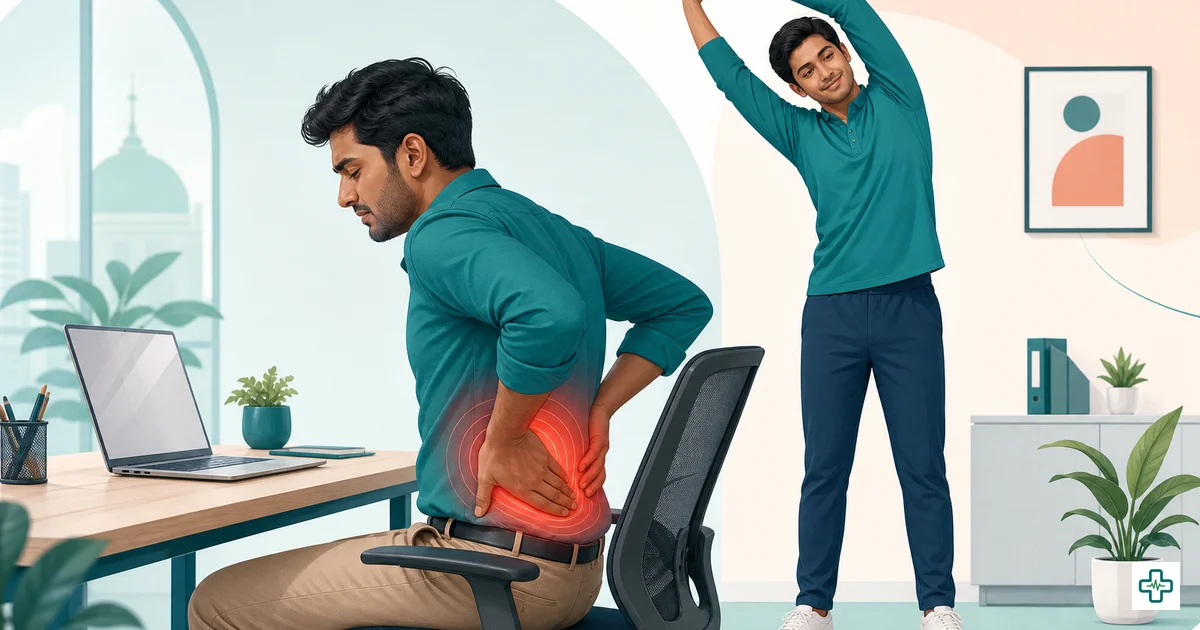
Sitting still for hours puts steady pressure on the discs and muscles of your spine, especially when you slouch or crane your neck towards a screen. Looking down at a phone bends the neck forward and adds many extra kilograms of strain. Over time, weak core muscles and tight hips from constant sitting leave the back doing more work than it should, and pain follows.
How should you set up your desk and chair?
Good posture is easier when your setup supports it, and you do not need expensive furniture. Aim for a few simple targets.
- Sit back fully so the chair supports your lower back; a rolled towel or small cushion behind the lower back works well
- Keep your feet flat on the floor (or on a stool), with knees roughly level with your hips
- Raise the screen so its top is at eye level, so you are not looking down
- Keep your shoulders relaxed and elbows close to your body
- Hold your phone up towards eye level instead of dropping your head
How often should you move during the day?
Movement matters more than any single 'perfect' posture. Try to stand up, stretch or walk for a minute or two every 30 to 45 minutes — set a reminder if it helps. Even short, regular breaks keep your muscles from stiffening and dramatically reduce end-of-day pain.
5 easy exercises for a stronger back
These gentle exercises help loosen tight muscles and build support for your spine. Move slowly, breathe normally, and stop if anything causes sharp pain.
- Cat-cow: On hands and knees, slowly arch your back up, then let it dip down. Repeat 10 times.
- Knee-to-chest: Lying on your back, gently pull one knee towards your chest and hold for 20–30 seconds. Do 2–3 times each leg.
- Pelvic tilt: Lying on your back with knees bent, flatten your lower back against the floor by tightening your stomach. Hold 5 seconds, repeat 10 times.
- Bridge: Lying with knees bent, lift your hips towards the ceiling, hold briefly, then lower. Repeat 10 times.
- Hamstring stretch: Sitting or lying, gently straighten one leg until you feel a mild stretch behind the thigh; hold 20–30 seconds each side.
What else helps — heat, ice or rest?
For a fresh strain, an ice pack in the first day or two can ease swelling, while heat (a warm compress or warm shower) relaxes tight, aching muscles afterwards. Sleep on your side with a pillow between your knees, or on your back with a pillow under your knees, to keep the spine neutral. Importantly, avoid long bed rest — staying gently active speeds recovery, while lying down for days makes the back weaker.
When should you see a doctor?
Most back pain eases within a few weeks, but some signs need prompt medical attention. See a doctor urgently if you have numbness, tingling or weakness in a leg, loss of bladder or bowel control, pain after a fall or accident, fever with back pain, or pain that is worse at night or simply not improving. You can book a verified doctor on ChamberBD if your pain is severe, spreading, or simply not getting better.
This article is for general health education and is not a substitute for professional medical advice.