Chamber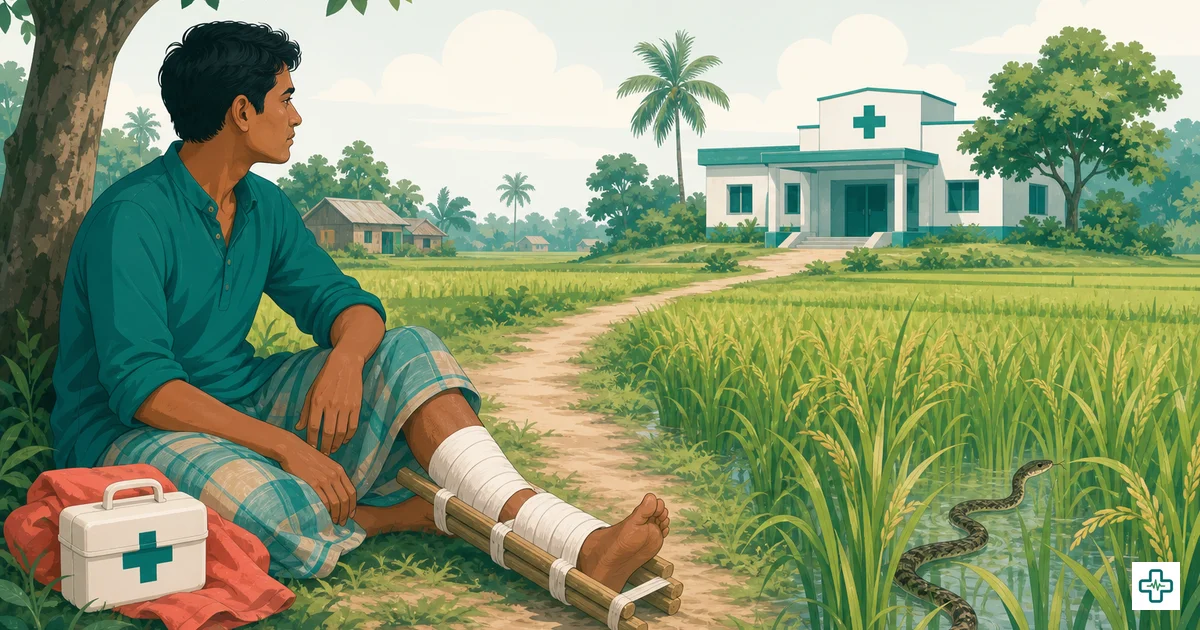
Snakebite First Aid: Life-Saving Do's and Don'ts for Bangladesh
Snakebite is one of rural Bangladesh's most serious and most neglected emergencies. Every year thousands of people are bitten — and the danger peaks during the monsoon and floods, when snakes are flushed from their holes and come close to homes and fields. Many deaths are tragically preventable: they happen not because antivenom is unavailable, but because precious hours are lost on the wrong 'treatments.' Knowing exactly what to do — and what never to do — can save a life.
What should you do immediately after a snakebite?
The single most important goal is to reach hospital fast while keeping the person calm and still, because panic and movement spread venom faster. Follow these steps:
- Stay calm and keep still. Reassure the person; fear speeds the heart and circulates venom.
- Immobilise the bitten limb like a fractured bone — keep it still with a splint and below heart level, and do not let the person walk if it can be avoided.
- Remove rings, bangles, watches and tight clothing near the bite before swelling sets in.
- Note the time of the bite and, only if it is safe, the snake's appearance or a photo from a distance — never chase or try to catch it.
- Get to the nearest government hospital immediately by the fastest transport available.
What must you never do?
Many traditional first-aid methods are useless or actively harmful, and delay is the number-one cause of snakebite death. Never do the following:
- Do not tie a tight tourniquet or rope around the limb — it can cut off blood flow and cause severe damage.
- Do not cut, prick or suck the wound, and do not try to 'draw out' the venom.
- Do not go to an ojha or rely on jhar-fuk and charms — this wastes the very hours that antivenom needs to work and costs lives.
- Do not apply herbs, chillies, cow dung, kerosene or other substances, and do not give alcohol.
How do you know if it was a venomous bite?
Not every bite injects venom, but you cannot judge this at home, so every bite must be treated as an emergency. Warning signs of a dangerous, venomous bite include drooping eyelids, blurred or double vision, difficulty swallowing or speaking, breathing trouble, drowsiness, bleeding from the gums or bite, dark urine, and severe pain or swelling spreading up the limb. Even a 'dry bite' with no early symptoms needs hospital observation for several hours, because the effects can be delayed.
Why you must go to hospital immediately
The only proven treatment for a venomous snakebite is antivenom, which must be given by trained staff under monitoring — and in Bangladesh it is available free of charge at upazila and district government hospitals. The earlier it is given, the better it works, which is why every minute counts and why faith healers cost lives. Go straight to the nearest hospital, not a distant private clinic. After recovery, you can follow up for wound care and advice with a registered doctor through our doctor directory.
How can you prevent snakebites?
Simple precautions sharply lower your risk, especially in the rainy season. Always carry a torch and watch your step when walking after dark; wear shoes or boots and long trousers when working in fields, bushes or after floods; and sleep under a mosquito net tucked in under the mattress, since this also keeps snakes away at night. Clear bushes, rubbish and rodent burrows from around the house, and store grain where it will not attract rats — and therefore snakes.
This article is for general health education and is not a substitute for professional medical advice.