How to reduce patient no-shows: what actually works in Bangladesh
You blocked the slot. The patient confirmed. At 7:15pm the chair stays empty, and three people who could have been seen are sitting at home because your assistant told them the evening was full. A no-show is not one problem — it is two. You lose the income from that slot, and a patient who needed care did not get it.
The good news is that no-shows are one of the most fixable problems in a chamber, because most of them are not deliberate. To reduce patient no-shows you do not need to punish people — you need to remove the small frictions and forgetfulness that cause most of them. This guide ranks the fixes by impact, gives you SMS templates you can copy in both Bangla and English, and shows you how to measure whether any of it is working.
Why patients in Bangladesh actually miss appointments
Before you fix the problem, name it honestly. In a Bangladeshi chamber, no-shows cluster around a handful of very human reasons:
- They simply forgot. The appointment was booked a week ago over the phone, written nowhere the patient can see, and life got busy. This is the single biggest cause and the easiest to fix.
- Transport and weather. Heavy rain, a transport strike, or a long CNG ride from a nearby upazila turns a marginal trip into a skipped one.
- They got better. The fever broke, the pain eased, and the visit no longer feels urgent — so they quietly drop it without telling anyone.
- They went elsewhere. A neighbour recommended another doctor, or a diagnostic centre's on-call physician saw them first.
- Serial uncertainty. This one is underrated. If a patient is not sure they will actually be seen today — "what if I go and sit for three hours and the chamber closes?" — the safe choice is to not go. Vague queues quietly manufacture no-shows.
Notice that only one of these (going elsewhere) is really about losing the patient. The rest are friction and forgetfulness, which means they respond well to the right nudge. If your queue itself is the problem, fixing that comes first; our guide to patient serial management covers how a transparent, time-windowed serial removes the "will I even be seen?" doubt.
The no-show fixes that work, ranked by impact
You do not need to do everything. Start at the top of this list, because the early items deliver most of the benefit for the least effort and cost.
SMS reminders (the highest-impact, lowest-cost fix)
A reminder the evening before, and a shorter one on the morning of the appointment, addresses the single largest cause of no-shows — forgetting. It is cheap, it scales, and it works in a country where almost every patient has a mobile and reads Bangla SMS. Two messages per booking is the sweet spot: one far enough ahead to let them plan, one close enough to act on. Templates are below.
Set realistic wait-time expectations
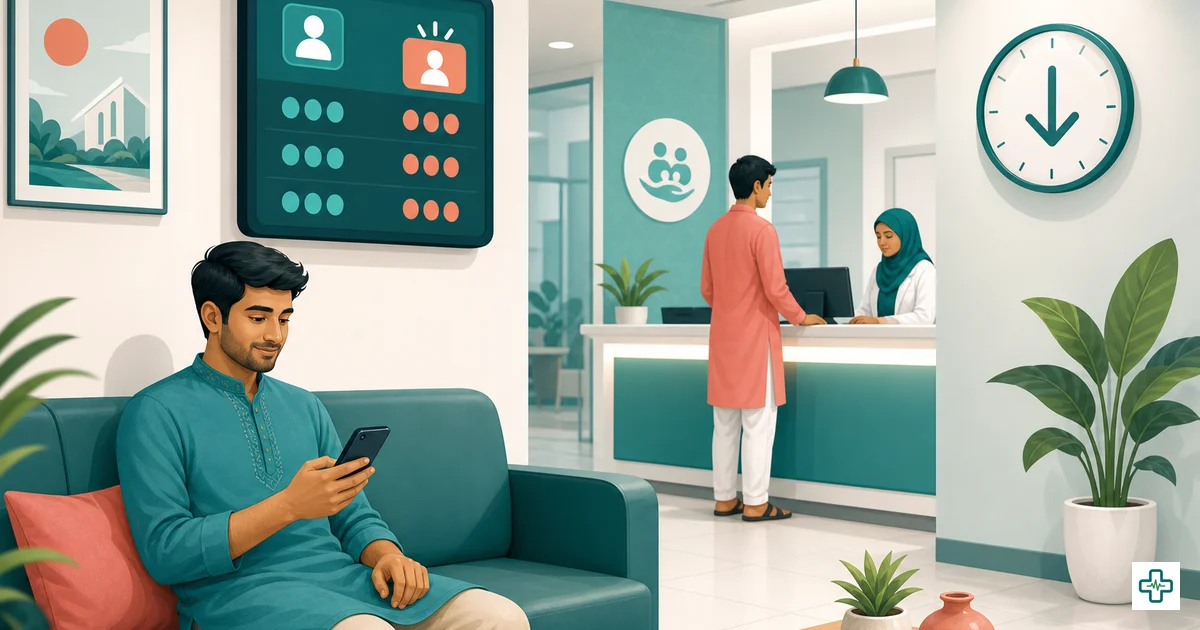
Patients are far more likely to come — and to come on time — when they know roughly when they will be seen. A serial of "8, around 7:45pm" is a small promise the patient can plan around. The opposite, a bare number with no time, encourages people to either crowd the door at opening or give up entirely. Honest time windows quietly cut both crowding and no-shows.
Rebook before the patient leaves the room
For any condition that needs a return visit, the most reliable time to book the follow-up is while the patient is still sitting in front of you. Hand them the next date and serial before they stand up. A booked follow-up with a reminder attached shows up far more often than a "come back in two weeks" said over your shoulder. This sits at the heart of any real patient follow-up system.
Confirmation call for procedures and high-value slots
You will not phone every patient — that defeats the purpose of automation. But for a scheduled procedure, a long specialist consultation, or any slot you cannot afford to lose, a short human confirmation call the day before is worth your assistant's five minutes. It catches the patient who has already decided not to come, freeing the slot in time to fill it.
Keep a waitlist to fill cancelled slots
No-shows hurt less when you can backfill them. Maintain a short list of patients who said "anytime this week is fine." When a slot opens — a cancellation, a no-show you spot early — your assistant calls the next person on the list. The income is recovered and a patient who wanted to be seen sooner gets in.
The advance booking fee debate: be honest about the friction
Sooner or later someone suggests charging a small advance fee — a bKash or Nagad deposit — to "make patients serious." It can work, but it is not free, and you should weigh it with open eyes.
- The case for it. A patient who has paid even ৳100 has skin in the game and is measurably less likely to vanish. For high-value procedure slots, a deposit can meaningfully protect your schedule.
- The case against it. It adds friction at exactly the moment you want booking to feel easy. Some genuine patients — especially first-timers, the price-sensitive, and older patients uncomfortable with mobile payment — will simply not book. You also inherit the awkwardness of refunds when you run late or cancel.
A reasonable middle path: keep ordinary consultations deposit-free and reminder-driven, and reserve advance fees for procedures or repeat no-show patients. If you do collect a deposit, make the bKash/Nagad step as simple as possible and state the refund rule plainly up front. A deposit is a tool for a specific problem, not a blanket policy.
Copy-ready SMS reminder templates (Bangla and English)
Good reminders are short, name the doctor and time, and tell the patient exactly what to do. Replace the bracketed parts with your own details. Keep messages under one SMS length where you can to control cost.
Evening-before reminder (English)
Dear [Name], reminder: your appointment with Dr. [Name] is tomorrow [Date]. Your serial is [No], around [Time]. Reply or call [Number] to cancel. — [Chamber]
Evening-before reminder (Bangla)
প্রিয় [নাম], মনে করিয়ে দিচ্ছি: আগামীকাল [তারিখ] ডা. [নাম]-এর সাথে আপনার অ্যাপয়েন্টমেন্ট আছে। আপনার সিরিয়াল [নম্বর], আনুমানিক সময় [সময়]। বাতিল করতে [নম্বর]-এ কল করুন। — [চেম্বার]
Morning-of reminder (English)
Dear [Name], today is your appointment with Dr. [Name]. Serial [No], please arrive around [Time]. Please come on time to keep the queue smooth. — [Chamber]
Morning-of reminder (Bangla)
প্রিয় [নাম], আজ ডা. [নাম]-এর সাথে আপনার অ্যাপয়েন্টমেন্ট। সিরিয়াল [নম্বর], অনুগ্রহ করে আনুমানিক [সময়]-এ আসুন। লাইন ঠিক রাখতে সময়মতো আসার অনুরোধ। — [চেম্বার]
Sending these by hand for forty patients a night is its own burden, which is why most chambers automate them. A tool like ChamberBD sends reminders automatically and fills in the serial, date and time variables for each patient, so the message goes out correctly without your assistant typing forty SMS by hand. You can see how the reminder and booking pieces fit together on the features page.
A reminder timing matrix: when to send what
The mistake is treating all appointments the same. A routine evening consultation and a scheduled procedure deserve different reminder rhythms. Use the matrix below as a starting point and adjust to your no-show data.
| Appointment type | Booking confirmation | Evening before | Morning of | Confirmation call |
|---|---|---|---|---|
| Routine consultation | SMS at booking | SMS reminder | Short SMS (optional) | No |
| Follow-up visit | SMS at booking | SMS reminder | Short SMS | No |
| Specialist / long consult | SMS at booking | SMS reminder | SMS reminder | Optional, for repeat no-shows |
| Procedure / high-value slot | SMS at booking | SMS reminder | SMS reminder | Yes — day before |
Two principles run through the whole table. First, every booking gets an immediate confirmation, so the patient has the date in writing from minute one. Second, the higher the cost of the empty slot, the more touches it earns — a routine visit gets one or two SMS, a procedure earns a human call as well.
How to measure your no-show rate (and know if this is working)
You cannot improve what you do not measure, and "it feels better" is not data. The formula is simple:
No-show rate = (patients who did not arrive ÷ total booked appointments) × 100.
Count it weekly. If 8 of 100 booked patients did not show, your no-show rate is 8%. Track it for a few weeks before you change anything to get a baseline, then turn on reminders and watch the number. A meaningful drop tells you the system is paying for itself; a flat line tells you the cause is something reminders cannot fix — usually queue uncertainty or patients genuinely going elsewhere.
A few practical notes on counting honestly. Decide a rule for late arrivals (for example, more than 30 minutes late counts as a no-show only if the slot went unused) and apply it consistently. Separate cancellations-with-notice from true no-shows — a patient who called to cancel let you backfill the slot and is a different, better problem. Compare like sessions: a rainy-night clinic and a normal evening are not the same. You can review plan options for built-in reporting on the pricing page.
Frequently Asked Questions
What is a normal no-show rate for a doctor's chamber in Bangladesh?
There is no official national figure, so measure your own rather than chasing a benchmark. Many chambers find that consistent SMS reminders and clearer wait-time expectations noticeably reduce missed appointments. Track your weekly rate before and after you start reminders — your own trend is the number that matters, not an external average.
Do SMS reminders really reduce no-shows, or do patients ignore them?
Reminders work because the largest single cause of no-shows is simply forgetting, not unwillingness. An evening-before SMS gives the patient time to plan, and a morning-of message prompts action. Almost every patient in Bangladesh carries a mobile and reads Bangla SMS, which makes this the cheapest, highest-impact fix available to a chamber.
Should I charge an advance booking fee to stop no-shows?
Only for the right cases. A small bKash or Nagad deposit can protect high-value procedure slots and discourage repeat no-show patients. But it adds friction that turns away genuine first-time and price-sensitive patients, so most chambers keep ordinary consultations deposit-free and reminder-driven, reserving deposits for procedures and known no-show offenders.
When is the best time to send an appointment reminder?
Two touches work best: one the evening before, far enough ahead for the patient to plan around it, and a shorter one on the morning of the appointment to prompt action. For procedures or high-value slots, add a human confirmation call the day before. Sending a confirmation at the moment of booking helps too.
How do I fill a slot when a patient cancels at the last minute?
Keep a short waitlist of patients who said any time this week works. When a cancellation or early-spotted no-show frees a slot, your assistant calls the next person on the list. This recovers the lost income and gets a willing patient seen sooner, turning a cancellation into a win rather than a gap.
The fastest, cheapest way to start is to turn on automatic evening-before and morning-of reminders for every booking, then measure your no-show rate for a month. You can set that up — with reminders that auto-fill each patient's serial and time — by creating a free ChamberBD account and letting the system handle the messages your assistant used to type by hand.