How to start a private chamber in Bangladesh: step-by-step (2026)
You finished your degree, maybe an FCPS or MD, and now you want a room with your name on the door. Starting a private chamber in Bangladesh is not complicated, but the order in which you do things decides whether your first six months are smooth or stressful. This is the full checklist, in the sequence an experienced colleague would actually walk you through.
The short version: get your registration sorted, pick a location patients can find, keep the fit-out lean, hire one good assistant, and announce yourself to the people who already trust you. Everything below expands those five moves into concrete steps with realistic taka ranges.
Before anything else: confirm your BMDC registration
No chamber discussion matters until your Bangladesh Medical and Dental Council (BMDC) registration is current. Full registration — not just the provisional one you held during internship — is the legal prerequisite for independent practice. If you have just completed internship, make sure you have converted provisional to full registration and that it has not lapsed; renewal runs on a five-year cycle.
Two practical points people forget. First, your visible signboard and prescription pad must reflect only the qualifications you are actually entitled to display — the BMDC Code of Medical Ethics is strict about misleading degrees and titles. Second, if you trained abroad, finish your verification and registration process fully before you see a single private patient. Skipping this is the one mistake that can undo everything else.
How do you choose the right chamber location?
Location is the decision you cannot cheaply reverse, so spend real time here. The instinct to grab the cheapest room is usually wrong; the instinct to grab the most expensive prime spot is also usually wrong for a first chamber. Aim for the middle: a place patients can reach, recognise, and trust.
What genuinely matters:
- Proximity to diagnostic centers and a pharmacy. Patients leaving your room often need a test or medicine within minutes. A chamber on the same road as a reputable diagnostic center creates a natural two-way referral flow.
- Footfall and visibility. A ground or first-floor room on a busy road with a clear signboard beats a cheaper fourth-floor room down a lane, especially in your first year when nobody is searching for you by name yet.
- Transport and parking. Can a patient arrive by rickshaw, bus, or CNG without a confusing walk? Is there somewhere to leave a motorcycle? Elderly patients and their attendants weigh this heavily.
- The neighbouring tenants. Other doctors nearby are an asset, not competition — clusters of chambers pull patients to the area. A building already known as a medical address does half your marketing.
Match the area to your specialty too. A gynaecologist or paediatrician benefits from a residential, family-heavy neighbourhood; a cardiologist or medicine specialist does well near a hospital or diagnostic hub. We break down rent by area type in the companion piece on chamber setup cost in Bangladesh, which is worth reading before you sign anything.
Renting the room: what to negotiate
Most new doctors rent a single room or share space inside an existing chamber complex or a diagnostic center. Sharing is the lower-risk start — you often pay per session or a fixed monthly amount and skip the full fit-out. If you take your own room, negotiate these points before signing:
- Advance and security deposit. Landlords commonly ask for several months of rent as advance. Clarify the amount, whether it is refundable, and the exact refund conditions in writing.
- Who pays for what. Utility bills, service charge, lift maintenance, and any signboard fee — pin these down so they do not appear as surprises.
- Permitted hours and signage rights. Confirm you can run evening sessions and mount a signboard of a usable size on the building front.
- Rent revision clause. Annual increases are normal; get the percentage or cap in the agreement rather than leaving it open.
- Exit terms. Notice period and deposit return timing matter if the chamber does not work out in year one.
Always put the agreement on paper, even with a landlord you know personally. A simple written tenancy agreement protects your advance and your right to practise there.
Trade license, signboard and the basic paperwork
A private chamber is a small business, so a few formalities apply. The exact list varies by city corporation, municipality, and union, but the common items are:
- Trade license from your local city corporation or municipality (paurashava/union parishad in smaller towns). Fees are modest and renewable yearly.
- TIN (taxpayer identification number). Practising income is taxable; getting a TIN early keeps you clean and is needed for many official steps anyway.
- Signboard approval and tax. Many local authorities charge an annual signboard tax based on size; budget for it and keep the receipt.
- Diagnostic/clinic licensing applies only if you run an attached pathology lab or facility under DGHS rules — a plain consultation chamber generally does not need a clinic license, but verify locally if you plan any procedures.
None of this is heavy. Spend an afternoon at the relevant office, ask exactly which papers a single-doctor consultation chamber needs in your area, and complete them before you open rather than after a problem.
Furniture and equipment: the lean essentials list
This is where budgets balloon if you let them. You do not need a luxury fit-out to earn patient trust — you need clean, functional, well-lit. Buy the patient-facing items well and economise on the rest. Here is a realistic startup cost breakdown; treat every figure as an indicative range that shifts with city, brand, and whether you buy new or second-hand.
| Item | Low (৳) | High (৳) | Notes |
|---|---|---|---|
| Doctor's desk + chair | 8,000 | 25,000 | A solid desk and a comfortable chair you sit in for hours |
| Patient + attendant chairs (3-4) | 4,000 | 15,000 | Do not cheap out — patients judge comfort here |
| Examination couch | 6,000 | 20,000 | With a privacy screen or curtain |
| Waiting-area seating | 5,000 | 20,000 | Bench or chairs for 4-6 people |
| Basic clinical kit (BP machine, stethoscope, thermometer, weighing scale, torch) | 5,000 | 20,000 | Specialty-specific tools add to this |
| Cabinet / file storage | 4,000 | 12,000 | Lockable, for records and supplies |
| Lighting + fan / AC | 6,000 | 60,000 | Good lighting is non-negotiable; AC optional in year one |
| Signboard | 5,000 | 25,000 | Size and lighting drive the cost |
| IPS / generator backup | 10,000 | 50,000 | Load-shedding insurance for evening sessions |
| Prescription pads, stationery, basics | 2,000 | 8,000 | Or go paperless from day one (see below) |
Two specialty notes. If you are a gynaecologist, dentist, or ENT specialist, your equipment line is the big variable — an examination chair or basic procedure setup can dwarf everything else, so cost it separately. And whatever your field, decide early whether your records will be paper or digital; a small upfront choice here saves years of messy files.
Hiring your first assistant
One good assistant transforms a chamber. They manage the serial, greet patients, keep records in order, handle phone calls, and protect your consultation time so you are not also the receptionist. For a starting chamber, one part-time or full-time assistant is enough.
Look for someone reliable, polite, and comfortable with a phone and a simple computer or app — patient-facing warmth matters more than a fancy CV. Be clear from day one about hours, salary, and the small things: how to take a serial, how to greet an anxious patient, what never to discuss outside the room. Confidentiality is part of the job, not an afterthought.
How should you set your consultation fee?
Pricing yourself is uncomfortable for most new doctors, so anchor it in reality rather than guesswork. Three inputs decide a fair fee: your qualification and specialty, the going rate among comparable doctors in that same area, and what patients there can realistically pay.
- Quietly find out what nearby doctors of your level charge — a new fee wildly above or below the local norm sends the wrong signal.
- Set a clear policy for follow-up visits within a window (a reduced or free re-visit within, say, 7-15 days is common and builds loyalty).
- Decide your payment methods up front — cash plus bKash/Nagad is the practical minimum, and digital payment also gives you a clean record.
For a fuller framework on this, the guide on how to set doctor fees in Bangladesh walks through positioning, follow-up policy, and revising fees over time without losing patients.
Announcing your chamber to the right people
You do not need an advertising budget. You need the people who already trust you to know where to find you. In order of return on effort:
- Ex-hospital colleagues and seniors. The consultants you trained under refer patients to people they know. Tell them, in person, where and when you sit.
- Nearby pharmacies and diagnostic centers. A respectful relationship with local pharmacists and lab staff brings a steady trickle of patients — and you reciprocate by referring tests their way.
- A simple Facebook page. Name, photo, qualifications (only what BMDC permits), chamber address, days, hours, and a phone number for serials. Keep it factual; avoid the over-claiming language the ethics code prohibits.
- Word of mouth from your first patients. The single most powerful channel. Run an unhurried, kind first month and your earliest patients become your marketing department.
Surviving your first month of operations
The first month is about building habits that scale. Three systems decide whether month two is easier or harder:
Serial and appointment flow
Decide how patients book — walk-in, phone, or an app-based serial — and stick to it. A predictable serial system reduces crowding, cuts waiting-room frustration, and signals professionalism. Even a basic appointment tool removes the chaos of an overflowing waiting room and constant phone calls.
Patient records you can actually find again
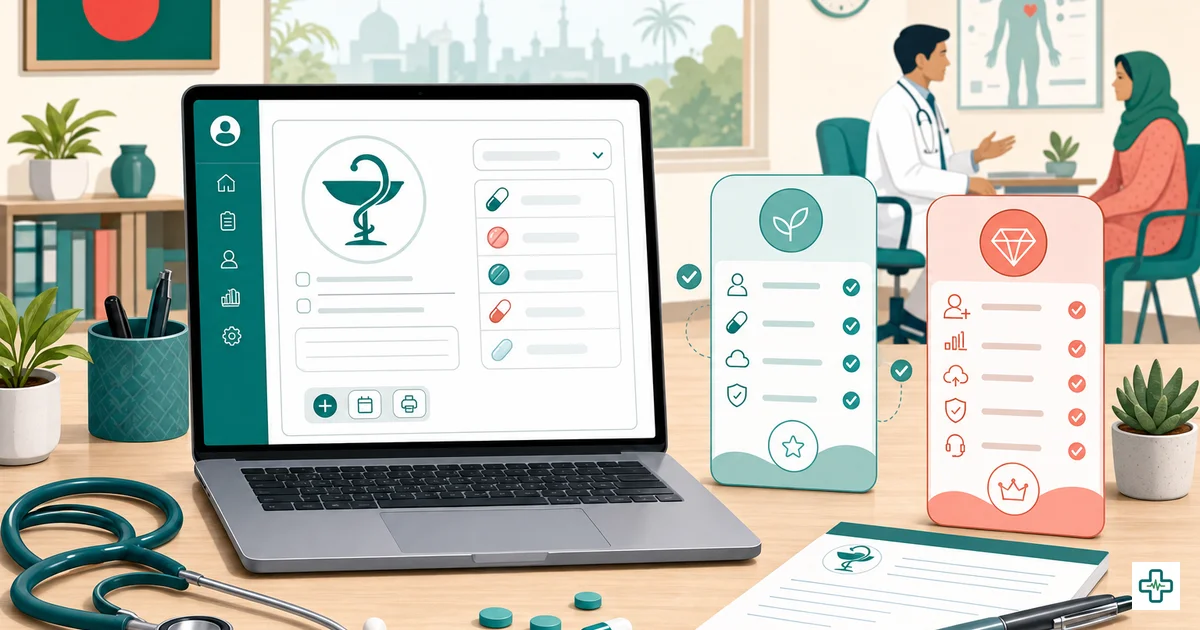
From your very first patient, keep a record you can retrieve on a return visit. A paper file works until it doesn't; a digital record means a returning patient's history is in front of you in seconds, prescriptions are legible, and nothing is lost when a register goes missing. This is exactly the gap a chamber-management platform like ChamberBD is built to close — appointments, digital prescriptions, patient history, and SMS reminders in one place, so a one-person chamber runs like a much larger one.
Follow-ups that bring patients back
A quick SMS reminder before a follow-up date, or a courteous call from your assistant, dramatically improves return rates. Patients who feel looked-after come back and refer others. Build this into your routine from week one rather than bolting it on later.
If you want to see how the appointment, prescription, and records pieces fit together before you commit, the features overview and the practical setup guide show the full workflow without any jargon.
Frequently Asked Questions
Do I need a trade license to run a private chamber in Bangladesh?
Yes. A private chamber is treated as a small business, so you need a trade license from your local city corporation, municipality, or union parishad, renewed yearly. You will also want a TIN, since consultation income is taxable. Requirements vary slightly by area, so confirm the exact list locally before opening.
How much money do I need to start a chamber?
A lean single-room chamber typically needs somewhere in the low-to-mid lakhs once you add rent advance, basic furniture, equipment, signage, and power backup. Sharing space inside an existing chamber or diagnostic center cuts this sharply. See our full cost breakdown for area-wise and item-wise ranges.
Can I start a chamber right after internship?
Only after you convert your provisional BMDC registration to full registration. Provisional registration covers internship; independent private practice requires full registration to be current and valid. Many new doctors also start by sitting a few evenings inside a senior's established chamber before opening their own room.
Should I use paper or digital records from the start?
Digital is far easier to scale and retrieve, especially for follow-ups and repeat patients. Starting paperless avoids the painful migration later when files pile up. A simple chamber-management app handles records, prescriptions, and reminders together, which a one-person chamber benefits from immediately.
How do I get my first patients?
Tell your ex-hospital colleagues and seniors where you sit, build respectful ties with nearby pharmacies and diagnostic centers, put up a clear signboard, and run a simple factual Facebook page. Then let an unhurried, kind first month turn early patients into word-of-mouth referrals.
Starting a chamber is mostly a sequence of small right decisions. Get the registration, location, and records right early, and the rest compounds in your favour. When you are ready to run appointments, prescriptions, and follow-ups without the paperwork chaos, set up your free ChamberBD account and have your chamber organised from day one.