Chamber
Telemedicine and the Future of Digital Healthcare in Bangladesh 2026: Why Doctors Who Don't Adapt Now Will Be Left Behind
Dr. Rafiq, a general physician in Mymensingh, noticed something alarming in early 2025. His patient footfall had dropped 25% over six months — not because people were healthier, but because a younger doctor two blocks away had started offering online appointment booking, digital prescriptions via WhatsApp, and follow-up consultations over video call. Dr. Rafiq's patients, especially the younger ones and those from rural areas, quietly migrated to the more convenient option. By the time he realized what was happening, he had lost over 200 regular patients.
This is not an isolated story. It is happening across Bangladesh right now.
The healthcare revolution in Bangladesh is not coming — it is already here. With over 130 million mobile internet users, the government's ambitious Digital Health Strategy 2023-2027, and a patient population that increasingly expects digital convenience, the question is no longer whether to digitize your practice. The question is whether you will do it before your competitors take your patients.
This comprehensive guide explores the telemedicine landscape in Bangladesh in 2026, the technologies reshaping medical practice, and exactly how you can future-proof your clinic starting today.

The State of Digital Healthcare in Bangladesh: 2026 By the Numbers
Telemedicine in Bangladesh 2026 is defined as the delivery of healthcare services remotely using telecommunications technology, including video consultations, digital prescriptions, remote patient monitoring, and online appointment booking — a practice that has grown 400% since 2020 in Bangladesh.
Understanding the current landscape reveals why digital adoption is no longer optional:
| Metric | 2020 | 2026 | Growth |
|---|---|---|---|
| Mobile internet users | 65 million | 130+ million | +100% |
| Telemedicine consultations/year | ~1 million | ~12 million | +1100% |
| Doctors using digital tools | ~8% | ~40% | +400% |
| Patients preferring online booking | ~5% | ~45% | +800% |
| bKash/Nagad active accounts | 40 million | 80+ million | +100% |
| 4G/5G coverage (districts) | 32 districts | 64 districts | 100% |
The data tells a clear story: Bangladesh's healthcare ecosystem is digitizing rapidly, and the 60% of doctors still using paper records represent an enormous opportunity — and an enormous risk for those who delay.
Government Digital Health Mandates: The Regulatory Push
Bangladesh's Digital Health Strategy 2023-2027, led by the Ministry of Health and Family Welfare in collaboration with the ICT Division, outlines concrete objectives that directly affect every practicing doctor:
- Electronic Health Records (EHR) — Mandatory adoption targets across healthcare facilities, starting with government hospitals and extending to private practice
- Telemedicine expansion to all 64 districts — With infrastructure investments making remote consultation viable nationwide
- Digital prescription standards — Interoperability frameworks that will eventually require standardized digital prescription formats
- Health information exchange systems — Cross-facility data sharing that demands digital record-keeping
- Data protection regulations — Formal requirements for securing patient health information digitally
Doctors who align with these objectives today will have a significant head start when compliance becomes mandatory. Those who wait will face rushed, expensive transitions under regulatory pressure. Learn more about how ChamberBD ensures data security compliance.
Telemedicine in Bangladesh: From Emergency Measure to Standard Care
The Three Phases of Telemedicine Evolution
Telemedicine in Bangladesh has evolved through three distinct phases:
- Emergency Phase (2020-2021) — Basic phone consultations during COVID lockdowns, unstructured and informal
- Maturation Phase (2022-2024) — Organized video consultations, appointment scheduling platforms, early digital prescription adoption
- Integration Phase (2025-present) — Telemedicine as a standard complement to in-person care, embedded into clinic workflows
The current hybrid model that delivers the best patient outcomes combines:
- Initial in-person consultation — Physical examination, baseline diagnostics, relationship building
- Follow-up via telemedicine — Review test results, adjust medications, monitor chronic conditions without patient travel
- Digital prescriptions — Updated prescriptions sent via WhatsApp or SMS after remote consultations
- Smart scheduling — Unified online booking for both in-person and telemedicine appointments
ChamberBD's online appointment booking system supports exactly this hybrid model — patients can book their preferred consultation type through your public profile.
Rural Healthcare Access: Telemedicine's Biggest Impact
With specialist doctors concentrated in Dhaka, Chittagong, and a few other cities, patients in rural Bangladesh often travel 4-6 hours for a 10-minute specialist consultation. Each trip costs ৳500-2,000 in transportation alone, plus a full day of lost wages. Telemedicine eliminates this barrier for follow-up visits, chronic disease management, and initial screenings — expanding your potential patient base from your local area to the entire country.
Consider this: A cardiologist in Dhaka who offers telemedicine follow-ups can serve patients across all 64 districts. Without telemedicine, those same patients must either make expensive trips or — more likely — simply stop following up, leading to worse health outcomes and lost revenue for the doctor.
Digital Prescriptions: The End of Illegible Handwriting
Why Digital Prescriptions Are Becoming Non-Negotiable
The limitations of paper prescriptions are well-documented and dangerous:
- An estimated 7,000 deaths annually worldwide are attributed to medication errors from illegible prescriptions
- No drug interaction checking — Paper cannot alert you to dangerous combinations
- Lost records — Patients frequently lose prescriptions, losing medication history
- No duplication possible — Patients needing refills from distant locations must travel back
- Zero analytics — No data on prescription patterns, common medications, or treatment outcomes
ChamberBD's prescription builder with 35,000+ Bangladeshi drugs solves every one of these problems — while creating prescriptions faster than handwriting. Doctors report saving an average of 3-5 minutes per prescription, which at 30 patients per day equals 90-150 minutes saved daily.
AI in Healthcare: From Hype to Practical Clinical Tool
How AI Is Actually Being Used in Bangladeshi Clinics Today
The conversation around AI has shifted from speculation to daily utility. In Bangladesh, AI is not replacing doctors — it is making good doctors even better:
- Drug interaction checking — AI cross-references prescribed medications against known interaction databases in real-time
- Differential diagnosis support — Based on symptoms and history, AI suggests possible diagnoses for the doctor to consider
- Clinical knowledge access — Query current treatment protocols, dosage guidelines, and clinical evidence without searching textbooks
- Documentation assistance — AI helps generate clinical notes, referral letters, and patient summaries
ChamberBD integrates Claude AI directly into the dashboard — giving you a medical knowledge assistant without switching applications, paying for separate subscriptions, or disrupting your workflow. Over 78% of ChamberBD users who try the AI assistant continue using it daily.
The Mobile-First Healthcare Revolution
Smartphones as the Primary Healthcare Device
With smartphone prices dropping below ৳5,000 for capable devices, penetration is expanding rapidly into rural and semi-urban Bangladesh. For doctors, this means managing your practice from anywhere: checking patient histories between hospital rounds, reviewing prescriptions during commutes, monitoring analytics from home.
WhatsApp as Healthcare Infrastructure
WhatsApp has become the de facto doctor-patient communication platform in Bangladesh. Patients send photos of previous prescriptions, lab reports, and symptom descriptions. Doctors share digital prescriptions and follow-up instructions. ChamberBD integrates with this reality by generating shareable prescription images and PDFs that can be instantly sent via WhatsApp.
Mobile Payment Integration
The bKash and Nagad revolution has fundamentally changed healthcare payments. With 80+ million active mobile money accounts, patients increasingly prefer digital payment. ChamberBD supports multi-method payment recording — bKash, Nagad, bank transfer, cash, and card — ensuring every transaction is captured regardless of how patients choose to pay.
Data-Driven Practice: From Intuition to Intelligence
Traditionally, Bangladeshi doctors made business decisions based on gut feeling. Smart clinic management platforms replace intuition with data:
- Revenue trend analysis — Month-over-month income changes with chamber, payment method, and visit type breakdowns
- Patient retention metrics — What percentage return, how often, which chambers retain better
- Busiest day/time analysis — Optimize schedules based on actual patient flow, not assumptions
- Referrer ROI tracking — Know which referrers send the most patients and calculate return on referrer relationships
- Expense visibility — Categorized expense tracking with automatic profit calculation
ChamberBD's analytics dashboard provides all these insights in real-time with graphical visualizations and exportable reports.
The Offline-First Imperative: Why Internet Dependency Is Dangerous
Bangladesh's internet infrastructure is improving, but variable connectivity remains a daily reality. Software that stops working when the internet drops is not just inconvenient — it is dangerous during patient consultations. ChamberBD's offline-first architecture ensures the 35,000+ medicine database syncs locally, patient records cache for offline access, and prescriptions can be created without internet — automatically syncing when connectivity returns.
Digital Practice vs. Paper Practice: The Compounding Gap
| Aspect | Paper-Based Practice | Digital Practice (ChamberBD) |
|---|---|---|
| Patient records | Lost, faded, duplicate entries | Permanent, searchable, auto-linked |
| Appointment booking | Phone calls, walk-ins only | 24/7 online booking + walk-ins |
| Prescriptions | 5-8 min handwriting, illegible | 2 min digital, shareable, verified |
| Financial tracking | Notebook guesswork | Real-time revenue + expense + profit |
| Patient reach | Local walk-in radius only | Online profile visible nationwide |
| Time spent on admin | 3+ hours/day | Under 1 hour/day |
| Regulatory readiness | Will require expensive migration | Already compliant |
The gap between digital and paper practices compounds daily. Every day without digital records is another day of lost data, lost efficiency, and lost competitive advantage. Doctors who build their digital presence today accumulate years of patient data, online authority, and operational efficiency that latecomers simply cannot replicate quickly.

How ChamberBD Prepares You for the Digital Healthcare Future
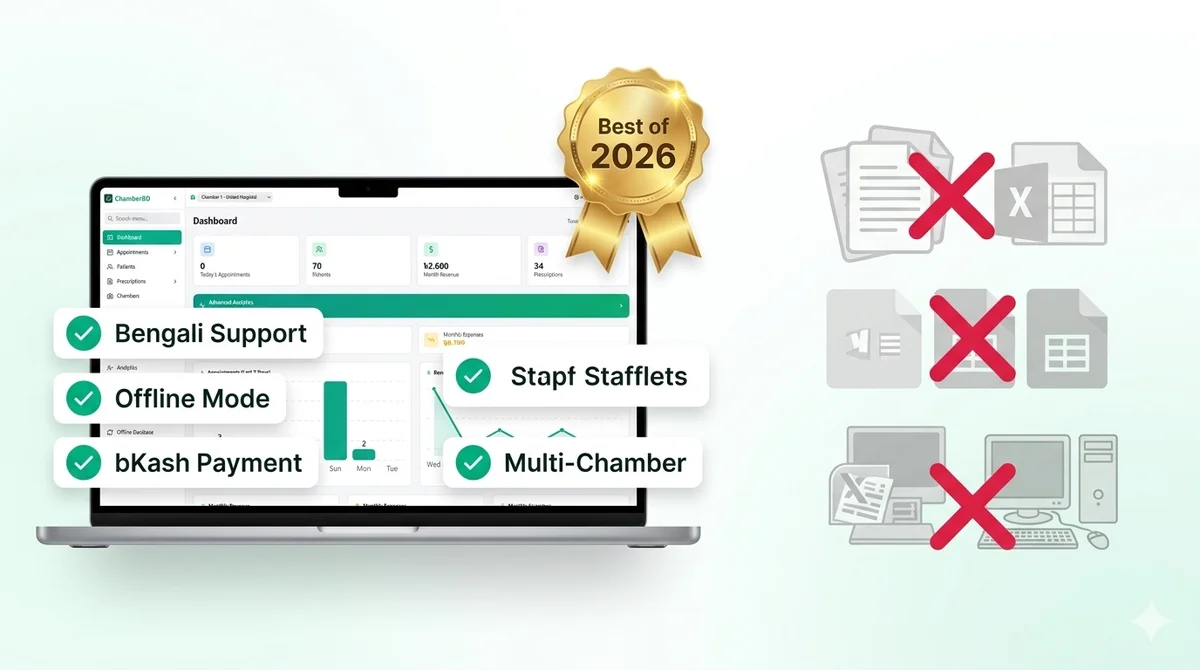
ChamberBD is not just clinic software — it is your complete digital healthcare infrastructure:
- Accumulated patient data — Years of digital records enable better clinical decisions and practice optimization
- Online presence and SEO — Your doctor profile gets indexed by Google, building authority that newcomers cannot replicate
- Operational efficiency — 30 minutes saved per day equals 180+ hours per year — time you can spend with patients or family
- Digital prescription sharing — Patients receive prescriptions instantly on their phones, improving adherence and satisfaction
- Regulatory readiness — When digital health regulations formalize under the 2023-2027 strategy, you will already be compliant
- AI-powered clinical support — Built-in AI assistant for drug interactions, differential diagnosis, and clinical queries
Frequently Asked Questions
Is Bangladesh ready for telemedicine and digital healthcare?
Yes. With 130+ million mobile internet users, mature mobile payment ecosystems (bKash/Nagad with 80M+ accounts), government policy support via the Digital Health Strategy 2023-2027, and improving 4G/5G coverage across all 64 districts, Bangladesh has the infrastructure foundation for digital healthcare. Adoption rates among both doctors and patients have accelerated 400%+ since 2020.
How do I start digitizing my medical practice?
Start with a comprehensive clinic management platform like ChamberBD that handles everything in one system — patient records, appointments, prescriptions, payments, expenses, and analytics. The setup takes only 15 minutes, and most doctors are fully operational within their first day. The 14-day free trial lets you experience digital practice management risk-free.
Will AI replace doctors in Bangladesh?
No. AI in healthcare is a decision-support tool that augments doctor capabilities. ChamberBD's AI assistant helps with drug interaction checking, differential diagnosis suggestions, and clinical knowledge queries, but the doctor remains in complete control of all clinical decisions. AI handles information retrieval; doctors handle patient care.
Is telemedicine legal in Bangladesh?
Yes. The Bangladesh government formally recognized telemedicine as a legitimate healthcare delivery method following the Telemedicine Guidelines issued during COVID-19. The Digital Health Strategy 2023-2027 further supports telemedicine expansion across all 64 districts.
How does digital prescription work with pharmacies?
Digital prescriptions from ChamberBD can be printed for traditional pharmacy submission or shared digitally via WhatsApp, SMS, or email. Patients present the digital version on their phone at the pharmacy. As Bangladesh moves toward electronic prescription interoperability, ChamberBD's format is already compatible with future pharmacy integration standards.
What happens to my existing paper records when I go digital?
Your historical paper records remain yours. Going forward, all new patient data is stored digitally. As returning patients visit, their digital records build automatically. You can also bulk-import existing patient data from spreadsheets or CSV files to accelerate the transition.